Showing posts with label Video Games. Show all posts

Monday, February 27, 2017

Middle-Earth: Shadow of War Announcement Trailer Thoughts


            Hey everyone!  They just released an announcement trailer for a sequel to Middle-Earth: Shadow of Mordor!  Let’s take a look!


            Well that looked like…a prerendered trailer that tells us nothing about the gameplay and only vaguely hints as to what the plot is about.  And that’s because it is a prerendered trailer that tells us nothing about the gameplay and only vaguely hints as to what the plot is about!  Now, to be fair, they say in the trailer that there will be a gameplay reveal released on March 8th and I fully expect myself to revisit this subject then.  But until then the only emotion that I can conjure up for this reveal trailer is “meh”.
            For those of you who don’t know, Middle-Earth: Shadow of War is a sequel to the 2014 game, Middle-Earth: Shadow of Mordor.  It was a game that actually surprised everyone at the time with just how good it turned out to be, especially given the questionable behavior Warner Brothers had displayed regarding the game’s promotion and the release of press copies to gaming critics.  For me, however, the game was just decent.  The Nemesis System was pretty cool and I did like how the developers gave the orcs distinct personalities as well as different weaknesses and fears to exploit.  It also happened to be one of the few instances where the game actually acknowledged the death of the player in a mechanical way which I thought was kind of nifty at the time. 
            Unfortunately, the game had no multiplayer to speak of, was populated by mostly boring supporting characters and had a plot that mostly consisted of taking control of orcs, making them war chief so you can move on to the big bad of the area only to find out you had to do it all over again.  Because of this I generally find myself discussing the odd continuity hiccups the game has in relation to the rest of The Lord of the Rings lore with my peers more so then the actual game itself.  And from the looks of this trailer, it looks as if it might be more of the same in this regard.
            All that this trailer seems to tell us is that the Gondor captain, Talion and the elf wraith Celebrimbor succeed in forging a new ring to challenge Sauron and the forces he still has in Mordor.  Not long after he apparently loses Celebrimbor and Sauron has gathered his forces to wage war on Middle-Earth and has somehow regained his physical form despite not having The One Ring.  And apparently, beta versions of the Ring Wraiths are flying around for some reason destroying stuff.  And he has a Balrog.  I have no idea how he got control of one of those.  And apparently Talion thinks he can stop all of this with his new magic ring.  Okay.  Again, just “meh”.
            Now to be fair, this is just an announcement trailer so maybe some of this stuff will be better explained in game.  Once again, we haven’t seen any gameplay footage of the new title so we should wait until we see some of that before we swing our expectations either way and I’ll be sure to revisit this subject once that happens.  So until next time, please follow the site, like the Facebook Page, follow me on Twitter and let's hope that the gameplay footage proves to be more promising.

Tuesday, January 31, 2017

Resident Evil 7

 
          The Resident Evil franchise is one that I cannot help but have mixed feelings on.  The first three games are straight up classics of the 5th generation era of gaming and really brought the horror genera to the medium in a way that few video games had managed to do.  But one cannot deny that they do not hold up particularly well.  Between the tank controls, god awful voice acting, constant use of tired genera clichés and a plot that got more and more ridiculous as time went on, the original games are a very hard sell for anyone who didn’t grow up with them.  Resident Evil 4, on the other hand, is not only a classic that holds up very well but a game that helped redefine the entire medium.  While there were undoubtedly other games that had tried, Resident Evil 4 was the first game to really prefect things that are now clichés of the medium such as epic scripted events, pop and cover shooting as well as the now hated quick time event.  The game also wisely abandoned the ridiculous story elements of the previous games in order to tell its own story that was equally ridiculous but was clearly more aware of just how silly its was and is one of my all-time favorite games as a result.
            Then Resident Evil 5 happened and the franchise went into a downward spiral that it never quite recovered from.  The game took itself far too seriously and tried to hammer in a political message regarding colonialism in Africa that went about as well as a man sporting a swastika showing up at a Holocaust memorial service.  And then we have Resident Evil 6.  Oh.  My.  God.  Resident Evil 6.  This game may have been the worst game that I ever had the displeasure of spending 60 dollars on.  It would take an entire article to go into why it is that I despise this game so much but should suffice to say that it was the game that effectively killed the entire franchise for me and up until recently I’ve wanted nothing to do with it.  But then 2016’s E3 happened and Nerd Hub editor Jack Flowers recommended that I take a look at Resident Evil 7’s first hour demo.  And, as anyone who read my E3 articles knows, it really put the hook in me and all but guaranteed that I would be taking a look at the game.  Now that the game has finally been released I can honestly say that it is easily the best installment since Resident Evil 4, even if it is far from perfect.
            In the game, you play as Ethan Winters, a relatively ordinary man who is called to an apparently abandoned estate in Louisiana by his wife who went missing three years ago.  At the estate, he finds a number of derelict buildings inhabited by the deranged Baker family affected by some mysterious affliction.  With little hope of rescue, it’s up to Ethan to fight and sneak his way through the estate, rescue his wife, find a cure for what is afflicting her and stop the force that caused all of this in the first place.
            The first thing most fans of the franchise will notice is how radical of a departure it is from previous installments.  Everything from the gameplay design to the narrative to the characters have next to nothing in common with previous entries.  In fact, had it not been for a few Easter Eggs connecting it to the larger RE Universe, one could have easily mistaken this game for an entirely new IP.  And if we’re being honest, this is a big part of what makes the game work so well.
            A lot of this has to do with the scale of the story being told.  Previous games had a tendency to focus on UN Bio CTU forces and Secret Service agents involved in world ending conspiracies fighting baddies who were equal parts Cronenbergian body horror mutations and hammy, sliver age comic book villains.  Resident Evil 7, however, abandons all of this to tell a smaller, more intimate story and this slips into nearly every aspect of the game.  The closest thing that one can compare it to is the 2014 game, Alien: Isolation.  Like Isolation, you play as protagonist who is by no means a soldier and is stuck in an isolated location with little hope of rescue and is one of the few sane people left to do anything about the current situation.  You're faced with seeming invincible enemies and are forced to sneak around them, finding ways to unlock new locations, dealing with a few generic enemies here and there, scavenging for supplies to make much needed weapons, ammo and med kits while doing a significant amount of back tracking to previously inaccessible points.  But in spite of all of these similarities the gameplay still manages to be incredibly satisfying.
            The first thing that it does right is create an incredibly creepy atmosphere as you are never sure what will be waiting for you around the next corner.  The lighting, sound design, voice acting and unsettling set design all help to create an unnerving environment that makes you take each step with caution.  This is especially true in the first half of the game where you are forced to sneak around invincible antagonists that each have their own unique abilities that you have to overcome.  The level design is a big part of this.  In total, the game only has 6 areas to explore and all of them are relatively small and do require a lot of backtracking.  However, like the antagonists, each environment has its own unique theme, be it bugs, bombs, or the natural uneasy feeling one gets from seeing a house in disuse and ultimately gives us an atmosphere that continues to be creepy but also manages to remain fresh with its variety.  Granted, these environments and antagonists borrow very heavily from franchises like Texas Chainsaw Massacre, Evil Dead and Saw but they come off more nostalgic tributes as opposed to blatant rip-offs
            Like Isolation, a good portion of the game involves running around these areas while looking for keys, wrenches and other tools in order to progress further in the game while sneaking around nigh invincible enemies.  However, the game manages to be a radical improvement over Isolation in two big ways.  The first is that antagonists don’t kill you in one hit, nor do they automatically sprint towards you the moment they spot you.  They will come at you and turn you into mints meat if they can but in taking away the one hit kill rule, they manage to keep the tension but lacks the same level of frustration as a result.  The second is that you never stay in any of these areas for too long.  Where as in Isolation you spend an infuriatingly amount of time backtracking to the same places over and over again, Resident Evil 7 knows just how long to keep you in certain locations.  You ultimately spend just enough time in each of these areas to become intimately familiar with them but not long enough to become sick of them and is where this game went right where Isolation went wrong.

           Unfortunately, like Isolation, the game features a pretty weak crafting system that felt very tacked on.  The entire system is more or less done by combining chemical fluids with other raw materials such as gunpowder and herbs to create ammo, med kits and such and lacks any real depth or variety.  However, the game does succeed in giving you just enough to get by for the most part.  Throughout the majority of the game you only ever have just enough ammo to get through enemies and only just enough healing materials to keep you alive.  This forces players to manage their resources carefully and actually think about when and how to use them as using too much at the wrong time can result in a position where the game in unwinnable.
            Unfortunately, this level of tension does not last the entirety of the game.  As the game goes on, Ethan obtains increasingly powerful weapons and by the time the game’s final act rolls around he’s armed like a space marine with assault rifles, flame throwers, and even a grenade launcher and is able to turn the enemies into goo without much problem.  By the time this happens most of the invincible enemies have been dispatched and your only left with the game’s generic enemies and the thing turns into a pretty bland corridor shooter and throws small waves of said enemies at you seemingly just to pass the time.  It tries to compensate for this by adding in phycological horror elements to the mix but they don’t work particularly well and ultimately feel like cheap attempts to make the player jump.
            Everything else about the game follows a similar pattern.  It’s all really good and entertaining but it usually comes with a pretty heavy stipulation.  The game’s main character Ethan is, in some ways, the perfect example of this.  Unlike all the other RE protagonists, Ethan, as far as we know, is just a regular guy who got caught up in this mess.  He is certainly capable but is very clearly out of his element and works perfectly as a player insert character.  Unfortunately, he doesn’t really amount to anything more than this.  He has no real defining characteristics and we know next to nothing about him by the time the credits roll.  We never see his face and what little dialog he has is very lazily voice acted and never amounts to much more than asking questions that the player is also more than likely asking.  One of the best examples of this is at the start of the game when you find Mia, Ethan’s wife.  Before long she goes berserk due to whatever affecting her and you are forced to put an axe in her neck.  It’s a pretty grisly scene but we get nothing in terms of emotion from Ethan.  He finds his wife who has been missing for three years only for her to try and kill him and is forced to apparently kill her in self-defense and his attitude on the situation amount to, “Huh.  That was freaky.”  It’s a very odd emotional disconnect that he has throughout the game and cannot help but take one out of it.
            Thankfully the game does make up for it with its antagonists.  Resident Evil villains have always been one of the more memorable parts of the franchise and this game is no exception.  In fact it could be argued that the game has the best antagonists that the franchise has ever produced.  At first the Bakers come off as a family of stereotypical redneck psychos and throughout most of the game they don’t really shake this appearance.  But they do manage to be the best version of the stereotypical psycho redneck family that you can possibly ask for.  Family patriarch Jack Baker is just a charisma machine and manages to find the perfect balance of humor and terror and you get the impression the voice actor was having a ton of fun doing the role.  The same can be said for his son, Lucas Baker.  The character is indeed horrifying as he takes sadistic pleasure in putting people through Saw-like death mazes but the voice acting behind it manages to find the right balance of horror and humor that you can’t help but have fun with it.
            In the end, what really elevates these characters past most Resident Evil antagonists is that there is a certain air of tragedy to them.  We don’t get a whole lot of information as to who these people were before the events of the game but what information we do get seems to indicate that they were otherwise pretty decent people.  Perhaps a little on the reclusive side but decent folks all the same.  In fact, it’s highly implied that it was that decentness that got them into this situation to begin with.  The same can be said of the game’s final antagonist.  I won’t spoil anything but it’s pretty clear that the character is one whose motivations are actually kind of pure in its intent, making the character’s situation feel all the sadder.
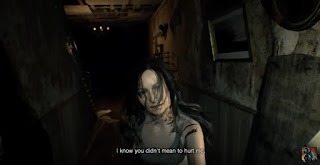
            The only character that they really dropped the ball with was Mia as she is one who has very little functionality or personality beyond being a damsel in distress.  Even when she finally breaks that mold she ultimately ends up inadvertently undercutting the quality of the story writing.  Later in the game she is eventually revealed to actually be one of the uber competent badasses that usually make up the protagonists of the this franchise.  At the same time, it reveals her to be the cause of all of the game’s problems as well as quite possibly the worst human being in the entire game.  The problem is that the developers don’t seem to be aware of this.  Revealing just what it is would constitute as a major spoiler but their does seem to be a major disconnect between the text and the subtext regarding this character.  As a result it’s kind of hard to figure out if this was meant to be a darkly ironic twist or if the writers didn’t actually know what they were implying with this.  Either way it just doesn’t work as well in its execution as it should have.

            In the end, Resident Evil 7 is a flawed game but still a fun one.  It features great antagonists, a fantastic horror atmosphere and tense gameplay that is sure to keep you on the edge of your seat.  Is it a masterpiece?  No.  Is it the best game in the franchise?  No.  But it is a decent little horror game that’s sure to scare and excite you for a good 15 hours or so.  Sometimes that’s enough.

                So until next time, please follow the site, like the Facebook Page, follow me on Twitter and let's hope that 2017 can keep producing good games.  It's shaping up to be an interesting year and it's still early enough to hope for the best.

Sunday, July 3, 2016

Resident Evil 7 Demo

            Well everyone, E3 is well and over but sadly, as per usual, I wasn’t able to cover as many things as I wanted to.  This was due to a combination of personal obligations, work commitments, and laziness and procrastination.  But after the last article involving Mass Effect: Andromeda, I wanted to end things on a more positive note.  To that end, let’s talk about the teaser for Resident Evil 7.
            The Resident Evil series is one that I cannot help but have mixed feelings on.  I understand that they are a staple of the survival horror genera, but the vast majority of them don’t hold up all that well.  The first three in particular had god awful voice acting, camera restrictions and crappy controls that were more frustrating than anything else, frequently employed genera clichés to an infuriating degree and contained plots that just got more and more ridiculous as time went on.  Resident Evil 4 wisely discarded all the Umbrella Corporation/Zombie baggage and told a much more interesting, self-contained story with a likeable cast of characters, interesting monster designs and far more fluid controls.  Then Resident Evil 5 managed to piss away all the good will the previous game had bought, turning the whole thing into a generic action game and disposing of most of the horror elements.  And Resident Evil 6…. was just terrible on every level.  There were also a number of other spinoff games but to be honest I could never be bothered with them and from the looks of things none of that actually matters with this game anyway.
            What is both fantastic and possibly frustrating about this demo is that it doesn’t actually seem to have anything to do with its predecessors in plot or gameplay.  There doesn’t appear to be any zombies, no Leon, no Chris Redfield, no Jill Valentine and no Umbrella Corporation.  If anything the game is taking notes from P.T., Outlast and Amnesia: The Dark Decent in style and presentation.  The characters you play as are apparently unnamed people who get locked in a haunted house and try to escape as things prevent them and that’s about it.  You explore this house through two different perspectives at different times and the result is something that is truly unsettling and disturbing.  It doesn’t rely on jump scares or quickly moving monsters to scare you.  The horror here is a bit subtler and if you rush through the demo you might just miss it.  As you go through the house you’ll notice that a lot of things about it are a bit off and as you move around things change.  For example, the whole house looks as if it hasn’t been used in decades yet it has relatively freshly cut meet just sitting around hallways.  In the distance you will hear noises but it’s hard to tell where it’s coming from and what exactly it is.  At other times your character will turn his head and look back only to find that several objects in the room have moved in dramatic ways with no indication as to how or why they moved.  At other times you’ll catch a glimpse of something disturbing but will disappear before you have a chance to get a good look.  Above all else, this demo understands that it’s what you don’t see that is the most frightening and plays that card to full effect.
            As far as the general gameplay goes, if this demo is any indication then it will be a game that forces you to use a small number of items to move around wherever your characters is and find your way out of whatever situation you happen to get into.  The over the top arsenal that you had in previous games seems to be gone and shooting your way out is no longer be an option.  But for more on any of this we’ll have to wait until the game comes out and the game explicitly says that what is in this demo may not be a representation of the final game. 
            Overall, the Resident Evil 7 Demo is a pretty good way to spend an hour and easily the best thing that the franchise has put out in a long time.  It was suspenseful, scary, and, above all, did its job and makes me want to buy the game.  It was a great way to end my look at E3 and I can’t wait to see more of this game. 
            So until next time, please follow the site, like the Facebook page and follow me on twitter and let’s hope that these games prove to be as good, (or in some cases better), as the trailers and demos promoting them.


Saturday, April 16, 2016

Initial Thoughts on Dark Souls III

            On the whole, the Dark Souls series is one that I have enormous respect for.  I respect its uncompromising difficulty, its minimalistic story, its gameplay that makes you think and plan out ever attack, and I love the overall apocalyptic tone that is infused with every game.  Unfortunately, I really, REALLY suck at them.  How bad am I at these games?  I couldn’t even get past the Taurus Demon in Dark Souls IThat is how bad I am at these games.  But in spite of this, I picked up Bloodborne last year and really enjoyed it.  In fact it might be safe to say that I put more hours into that game then I did any other last year and I eventually conquered it, (though admittedly with A LOT of help), and because of this I was more than willing to give Dark Souls III a shot.  Unfortunately, it’s probably going to take me all year to beat this game so a full review is out of the question.  But I had a Saturday slot to fill and this seemed like the best thing to write about at the moment.
            So the bottom line is this; is the game any good?  Absolutely and from what I’ve played so far there isn’t a “but” in this statement.  The plot, once again, is very vague and difficult to follow unless you’re really paying attention but this time it seems a bit more straight forward then Dark Souls II or Bloodborne and feels easier to follow, (or maybe I’ve just gotten better at following the plots of these games).  Like the previous games, it requires A LOT of exploration and item description reading in order to find out what is going on but whereas many of the secrets in previous games felt needlessly cryptic, most of the hidden, plot important detail stuff that I’ve encountered was found by simply taking an alternative path.  Sometimes it resulted in a horrible death and sometimes it resulted in finding something that gave a bit more context to what I was fighting, (or both), but in either case I’ve yet to feel as if my time was wasted.  Because of this I’ve found myself really wanting to explore the huge environments and discover every little obscure thing the game has to offer because whether or not it results in a horrible, unexpected death or meeting an NPC who give you information on the axe wielding giant you’re about to square off against the result is always fun and rewarding.
            One of the big problems that I had with the previous Dark Souls games was that they always seemed to tanky; as if blocking is your only real option against your enemies and pray that you had enough stamina to attack, (gross oversimplification I know), and Bloodborn kind of had the opposite problem. In that game all you could do was dodge everything and then hit the enemy as much as you could before running away, (again, I know it’s a gross oversimplification).  Dark Souls III, however, seems to have found a good middle ground between the two.  The blocking is there and necessary at times to be sure, but this time around it feels more like an option as opposed to a requirement, with character customization allowing you to make a character who can be agile enough to dodge attacks but tough enough to block them as well.  Enemies, likewise, have attacks and move sets that reflect this.  They’re tough to be sure but never unfairly so and generally follow some kind of pattern that is exploitable regardless of how difficult it might be to exploit said pattern.  All of these things make for a game that is still very challenging and unforgiving but, at the same time, feels far more accessible than previous installments.

            Unfortunately, this is all I really have to say on the game at the moment.  It’s ultimately far more accessible than previous installments with gameplay that feels balanced for the first time.  It both punishes and rewards the player for exploration but always ends up feeling fun regardless of what path you take and that’s what I’ve taken away from it so far.  It’s a challenging game but also a very fun one and I cannot wait to play more of it and highly recommend that you take a look for yourself. 
             So until next time, please follow the site, Like the Facebook page and follow me on twitter.  Until then, Farewell Ashen Ones.  May the Flames Guide Thee.

Saturday, April 9, 2016

The Banner Saga Review

            The more and more I think about the entertainment industry these days, the more depressed I seem to get.  Within the comic industry writers and artists are constantly hindered by editorial mandates in order to line their books up with much larger publisher plans as opposed to telling a good story.  The film industry seems to be unable to release anything but sequels or adaptations based off of some 80s/90s nostalgia products or artsy award bait that no one will remember in six months.  And then we have the video game industry.  Where do we even start with it?  Should we talk about how the publishing companies have no respect for their own products as art?  Should we talk about how the bloated budgets of the AAA branch of the industry effectively insure that most of them will never see a profit?  Should we talk about how the industry is constantly nickel and diming us with microtransaction for content that should have been in the core game?  Should we just talk about the fact that so many of these games aren’t even in working order at launch and have to be fixed through a series of patches weeks or even months after the initial release?  The list goes on and on.
            Luckily it’s not all bad.  Many of the nostalgic properties that these films are based on often turn out to be pretty decent movies, most notably those of the Marvel Cinematic Universe and comic industry still has many talented people working within that know how to work with publishers in order to get the stories they want told.  The video game industry, on the other hand it another matter.  Sure, there are great AAA releases every year but it seems like for every Witcher 3 or Bloodborne there is Battlefront or a Batman: Arkham Knight or an MGSV which probably accounts for why so many internet personalities tend to gush over certain independent video games.  Granted there are many more bad independent video games out there then good but free of the shackles of the AAA industry, many talented developers have been able to develop their own original IPs and every now and then you get something truly memorable that that you will be thinking about long after the credits roll.  Which brings us to The Banner Saga; a small Viking-themed tactical RPG, made by a team of former BioWare developers who managed to beat their old bosses at their own game.
           
        Taking place in a fantasy world inspired by Norse Mythology, the game follows a hunter from a small village named Rook who must lead an ever growing band of followers west, away from a seemingly unstoppable horde of stone/metallic creatures known as the Dredge.  With his daughter and a number of other heroes in tow the group will face hardships including starvation, attacks from bandits, Dredge, insurrections from the very people they rescue and simple bad luck that comes about during a journey but will hopefully find a safe haven from this new threat.  There are a number of things that makes this particular plot unique and endearing.  The main thing is that it is a completely unique IP and doesn’t seem to directly lift anything from any pre-existing IPs.  There aren’t any orcs or goblins roaming the countryside, dwarves hold up in mines or arrogant elves who think they know better than everyone else.  Instead it takes on an overall tone that is clearly inspired by Viking culture and Norse Mythology.  Granted it does seem to lift a lot from this culture to the point that this world seems to take place after some kind of Ragnarok event, but the various races and creatures encountered within the game seem to be the developer’s own unique creation and discovering the stories behind these races, kingdoms and such is done in a natural way that doesn’t resort to overly long exposition making the whole experience a delight.  It’s only real downside is that the plot itself doesn’t amount to much more than a road trip and is clearly meant to be the first act to a much larger story.  Because of this, many major plot points are left entirely unresolved and unlike franchises like say Dragon Age, it’s going to leave the player feeling frustrated as opposed to wanting more.    
           
           The gameplay itself is effectively broken down into two parts; the RPG/caravan half and the tactical grid based combat half.  Throughout the entirety of the game, you are leading a caravan of survivors and must decide how to effectively lead them to safety.  The mechanics of it are relatively simple.  You have a number of villagers, fighters, and giants known as Varl within your caravan who are constantly consuming food that at times can be very hard to come by which can lead to large numbers of your people dying off or fleeing the caravan should supplies run out.  Once you enter combat you have to decide how you will lead your soldiers, effectively deciding how many of them will live or die during the fighting itself.  All of this leads you to make meaningful decisions that, unlike similar game such as Fire Emblem and some of BioWare’s more recent outings, can potentially have short and long term consequences for the characters.   For example, on the trail itself you will often run into people who may or not be trouble for your group.  In some cases you will encounter people who will raise the spirits of you caravan members and bring much needed supplies and soldiers to help fight through your enemies.  Unfortunately it is equally as likely that whoever you are helping will simply drain your resources or steal precious food.  In some cases your actions can also lead to the deaths of major characters with seemingly insignificant actions having unexpected results that will shock and horrify the player as they see their poor choices play out and potentially have favorite characters meet their end.  The one admittedly big problem that this half has is that the events in question are described to you through text descriptions as opposed to actually showing you through a cutscene or gameplay.  While it is understandable due to the fact that this is a low budget indie game, one cannot deny that these moments would have had a lot more impact if they had played out another way.
            Unfortunately it’s during the combat sections of the gameplay where the game comes up a bit short.  Like Fire Emblem, the game uses a grid based combat system and effectively ends when one side has lost all of their units.  Unfortunately, this game’s combat system lacks the complexity and depth that those games had to offer.  Weapon types don’t seem to matter as much as they should and so called special attacks don’t give you nearly enough of an advantage over the enemy as a basic attack would.  The amount of damage attacks do ultimately comes down to how much armor the person is wearing and how much health they have.  Armor effectively reduces the amount of damage the character in question takes and can sometimes eliminate damage all together if the armor score is higher than the attacker’s strength.  The amount of strength the character has is determined by their strength bar which doubles as a health bar and as the character takes more damage, the less effective his/her attacks are.  While admittedly it is an original combat system that showed some promise, it never quite lives up to it and you’ll more than likely be using the same strategy in every battle that will involve chipping away an enemy’s armor before delivering a series of killing blows.  While this kind of strategy is a good foundation to build your game around, the developers were either unable or unwilling to add some much needed variety to this process beyond melee and ranged attacks and this unfortunately makes the whole thing feel like a slugging match between the heroes and antagonists.
           
            What really brings the whole thing together, however, are the characters as the developers knew how to invest you in their struggle to survive as well as applying original personalities to the majority of them.  Rook for example isn’t a young hero in his prime, battling an evil force.  He’s actually a middle aged hunter with a fully grown daughter who had this responsibility suddenly thrown on him and the game makes you feel the weight and stress of each decision.  The game also features a roster of twenty three recruitable heroes and does a good job of developing the vast majority of them with relatively limited screen time for some.  For example, the game features two twin characters who, in a more poorly written game, would have been completely disposable and interchangeable.  However, the writers were smart enough to give the two distinct personalities, with one being a more rash and impulsive individual and the other being a more level headed thinker.  The game is also one that develops its characters through action and dialog as opposed to exposition.  Granted there is exposition on some of the characters backgrounds and it is appropriate when it comes up, but for the most part everything you need to know about these characters is done through casual dialog with one another that feels natural.  A great example of this is the banter between the Varl characters Krumr and Ubin who are always arguing over which of the two is the oldest of the Varl.  Why are they always debating this?  Well, the game doesn’t outright tell us and it makes us speculate as to what their history is and in turn makes them all the more interesting and the vast majority of the characters are written in a similar way; ways that give us enough information on them so that they have a developed a sense of identity but leave enough out so that they may surprise us with their actions and odd quirks.
Unfortunately there are several characters who aren’t nearly as well developed as they should have been.  This happens mostly with the Varl characters, many of whom were clearly put in as a means to bolster the number of heroes in the game but lacked much of a developed sense of identity.  It also doesn’t help that, once again, this game is clearly the first act in a much larger story that has yet to be finished and because of this, it feels as if potential arcs the characters were meant to go through were only left partly finished.
Despite its flaws, The Banner Saga was an incredibly enjoyable experience.  The story, though unfinished, was an incredibly enjoyable experience and discover this new setting was an utter delight.  The majority of the characters were relatable and well developed and the game knew how to make you sympathize with them and completely invest you in their fates.  While the combat based gameplay was less than stellar, the decision based caravan portions of the game were nothing short of amazing and should be the model for decision based storylines in video games in the future.  With The Banner Saga 2 due for release later this month, I highly recommend that you give this one a try even if you aren’t that big on independent games.  Trust me when I say, you will not have wasted your time.

           So until next time please like the follow the site, like the Facebook page and follow me on Twitter.  It feels so good to be back doing this.  

Saturday, July 11, 2015

R.I.P. Kojima Productions

            Well everyone, it seems that the moment that many gamers have been fearing for months has finally happened; Kojima Productions has been disbanded.  The news came from Akio Otsuka, the Japanese voice actor for Solid Snake via his twitter account late last night with studio’s latest game, Metal Gear Solid V: The Phantom Pain nearing completion.  But while we had all been seeing this coming for months, it is, none the less, a sad occasion.
            For those of you who aren’t aware, Kojima Productions is/was a subsidiary game development studio under Konami headed by a man named Hideo Kojima and was best known for their development of the Metal Gear Solid series.  Under the development of the team, each entry in main games of the franchise have sold millions of copies and won numerous Game of the Year awards over series near thirty year history and is often a referenced point whenever someone points to games as being an artistic form onto themselves.  Solid, confirmed sources as to just what happened between Kojima and Konami are a little hard to come by but for the past several months rumors have been leaking that Konami’s executives had been feuding with Kojima for undisclosed reasons.   The result of this has been the unfortunate cancelation of the Kojima/del Toro Silent Hill reboot, Silent Hills as well as scrubbing Kojima’s name from the upcoming Metal Gear Solid V: The Phantom Pain, reinstating the games developers as “contractors”, resulting in the vast majority of the studio’s team planning to leave the company once the game was complete. 
Now personally, I am not a game journalist so I don’t have a grasp on the situation as others might nor do I have a full view on just how insane the company has become as a publisher.  For those interested on more information on the matter from professionals I would recommend taking a look at the Jim Sterling videos, R.I.P. P.T,-Why We Can’t Keep Nice Things, Konami is Konami, and a video by Super Bunnyhop entitled Kojima vs. Konami: An Investigation as both of them seem to have a better handle and more information on the situation then I do.  It should, however, suffice to say that Konami has had a long history of ineptitude when it comes to being a videogame publisher as well as being downright spiteful and petty when it comes to anyone who disagrees with and criticizes its policies.  Recently, it would appear that this petty spite is now being directed at Kojima as well to the point where his name wasn’t even allowed to be uttered during any kind of promotion at this year’s E3.
            Now to be honest, this news probably doesn’t affect me as it does others.  Metal Gear Solid 3: Snake Eater is one of my all-time favorite games but beyond that entry, I never had much exposure to the series.  I never was able to get into the Silent Hill series but the idea of Kojima being involved, by the sheer amount of respect his name carried in the gaming community, paired with del Toro, one of my all-time film makers, had me hyped for the game beyond all belief and I was completely and utterly crushed at the announcement of the game’s cancelation.  So while I am not as mad as others may be at this news or the general way Konami has allegedly treated Kojima I am deeply saddened by it and feel for those who are going to have their favorite video game franchises butchered as a result of this mess.

            In the end all we can do is hope that Kojima Productions’ final game will be a fine one and I have every confidence that Kojima and company will land on their feet with some other publishing company or on their own.  But for now it is a sad day for the gaming community.  Rest in peace Kojima Productions and thank you for all the hours of joy that you have brought gamers over the years.